
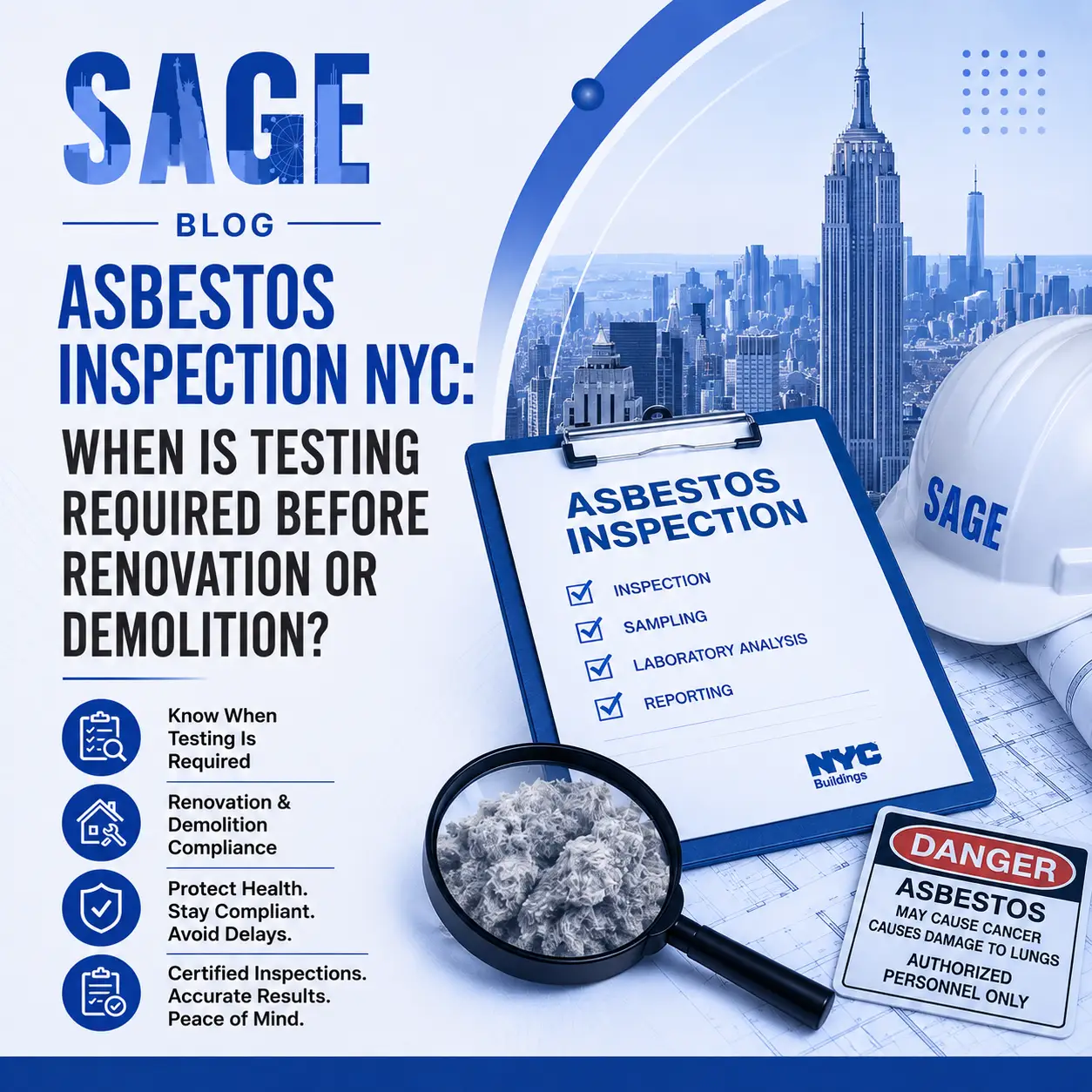
Asbestos Inspection NYC: When Is Testing Required Before Renovation or Demolition?
Planning a renovation, alteration, or demolition project in New York City? An asbestos inspection may be one of the first compliance steps you need to complete before construction begins.
Asbestos-containing materials (ACM) can be found in many older buildings, including materials used in flooring, ceilings, walls, roofing, insulation, piping, and other building components. Disturbing these materials without proper identification and controls can create health, environmental, regulatory, and project-delay risks.
In New York City, building owners are responsible for determining whether asbestos-containing materials could be disturbed by proposed work. The NYC Department of Environmental Protection (DEP) requires building owners to have an asbestos survey performed by a DEP-certified asbestos investigator (CAI) when applicable.
For property owners, developers, contractors, architects, and building managers, the key question is: Do I need an asbestos inspection before renovating or demolishing a NYC property?
In many cases, the answer is yes—especially when existing building materials will be disturbed.
What Is an Asbestos Inspection?
An asbestos inspection, often called an asbestos survey or assessment, is a professional evaluation performed to identify materials that may contain asbestos and determine whether proposed construction activities could disturb them.
A qualified investigator reviews the building and the planned scope of work, identifies suspect materials, collects samples when appropriate, and coordinates laboratory analysis through qualified laboratories.
The purpose is not simply to determine whether asbestos exists somewhere in a building. The critical issue is whether asbestos-containing material could be disturbed by the specific construction work being proposed.
SAGE Engineering provides asbestos consulting services that include asbestos surveys and material sampling, laboratory analysis through accredited partners, abatement oversight, third-party air monitoring, and removal/remediation cost estimates.
When Is Asbestos Testing Required in NYC?
NYC asbestos requirements generally become relevant when construction work may disturb existing building materials.
According to NYC Department of Buildings guidance, projects involving buildings constructed before April 1, 1987 may require asbestos assessment before permits, particularly where existing materials could be disturbed. Certain projects involving buildings constructed after April 1, 1987 can qualify for an asbestos exemption, subject to the applicable requirements and project conditions.
Common projects that may require asbestos assessment include:
- Interior renovations
- Apartment renovations
- Commercial build-outs
- Building alterations
- Plumbing and mechanical work
- Flooring replacement
- Ceiling or wall demolition
- Electrical work involving existing materials
- Façade or exterior work that may disturb suspect materials
- Roof work
- Partial demolition
- Full building demolition
- Major remodeling projects
The deciding factor is not simply the age of the building. The proposed scope of work and whether existing materials may be disturbed are critical.
Do I Need an Asbestos Inspection Before Demolition?
For demolition projects, asbestos assessment is particularly important.
Federal asbestos NESHAP requirements generally require a thorough inspection before regulated demolition or renovation activities. EPA guidance states that the inspection should identify asbestos-containing materials in the areas where demolition or renovation will occur.
NYC has additional local requirements administered by DEP.
For a full demolition application, NYC DOB states that an ACP-5 asbestos assessment must indicate that the entire building is free of asbestos-containing material for the demolition permit process, subject to specific exceptions such as certain simultaneous demolition/abatement procedures.
This is why asbestos planning should happen before demolition begins, not after contractors are already mobilized.
What Is an ACP-5 Form?
The ACP-5 Asbestos Assessment Report documents the findings of an asbestos investigation.
A DEP-certified asbestos investigator may complete an ACP-5 when the affected area is determined to be:
- Free of asbestos-containing material;
- Containing ACM that will not be disturbed by the proposed work; or
- Subject to a minor asbestos project under the applicable NYC requirements.
The ACP-5 can therefore play an important role in the NYC DOB permitting process.
For property owners and project teams, the practical lesson is simple: do not wait until the DOB application is ready to determine whether asbestos documentation is required.
Addressing asbestos requirements early can help reduce avoidable objections, redesign, contractor delays, and unexpected abatement costs.
What Is an ACP-7 Form?
If the proposed work qualifies as an asbestos project, additional notification and abatement requirements apply.
NYC DEP defines an asbestos project as work that will disturb more than 25 linear feet or more than 10 square feet of asbestos-containing material under its applicable rules. An ACP-7 Asbestos Project Notification must generally be submitted at least seven days before the project begins.
When asbestos abatement is required, building owners must retain an appropriately licensed asbestos abatement contractor and an air-monitoring company as required by NYC regulations.
Because project classifications and filing requirements depend on the specific scope, quantities, building conditions, and applicable regulations, a qualified asbestos professional should evaluate the project rather than relying on a generic threshold alone.
What Happens During an NYC Asbestos Inspection?
A typical asbestos inspection process may include:
- Review of the project scope. The investigator reviews architectural drawings, construction documents, proposed demolition areas, and the planned scope of work.
- Building and material inspection. Suspect materials in affected areas are visually inspected and documented.
- Material sampling. Where appropriate, samples are collected from suspect materials for laboratory analysis.
- Laboratory analysis. Samples are analyzed by an appropriately qualified laboratory to determine whether asbestos is present.
- Assessment and documentation. The investigator determines how the findings relate to the proposed construction activities.
- Regulatory filing. Depending on the findings and project classification, appropriate asbestos documentation and notifications may be required.
- Abatement and monitoring. If ACM must be removed or disturbed, qualified abatement professionals and required monitoring procedures are implemented before or during construction.
This process gives the project team a documented basis for making decisions about asbestos and construction sequencing.
Where Is Asbestos Commonly Found in Older NYC Buildings?
Asbestos can occur in many building materials. Potential locations include:
- Pipe and boiler insulation
- Floor tiles and associated mastics
- Ceiling tiles
- Plaster and joint compounds
- Roofing materials
- Window and door components
- Cement products
- Fireproofing
- HVAC components
- Mechanical insulation
- Electrical materials
- Wall and ceiling systems
Importantly, you cannot reliably determine whether a material contains asbestos simply by looking at it. EPA recommends professional sampling when suspect materials may be disturbed during renovation.
Asbestos Inspection vs. Asbestos Abatement: What’s the Difference?
These terms are often confused.
Asbestos inspection identifies and assesses suspect asbestos-containing materials.
Asbestos testing generally refers to collecting and analyzing samples to determine whether asbestos is present.
Asbestos abatement involves controlled removal, encapsulation, enclosure, or other approved management activities when required.
An inspection does not automatically mean that asbestos must be removed.
The appropriate response depends on the material, its condition, its location, the planned work, the quantity involved, and applicable NYC, New York State, and federal requirements.
What Are the Risks of Starting Renovation Without an Asbestos Survey?
Beginning construction without properly addressing asbestos can create significant problems.
Health risks.
Disturbing asbestos-containing materials can release airborne fibers. Proper controls are therefore essential when ACM may be disturbed.
Regulatory risks.
NYC DEP states that failure to perform the required asbestos survey or retain the appropriate licensed abatement contractor can result in penalties ranging from $1,200 to $10,000 per infraction.
Construction delays.
Unexpected asbestos discoveries can stop demolition or renovation while additional investigation and abatement planning takes place.
Increased project costs.
Late asbestos discoveries may require emergency investigation, redesign, contractor remobilization, additional abatement, and schedule extensions.
Permit complications.
Asbestos documentation can be part of the DOB permitting process for applicable projects. Resolving asbestos requirements early helps the project team coordinate compliance before construction.
For broader construction risk planning, see SAGE's independent construction safety oversight guidance.
How Early Asbestos Planning Can Save Your NYC Project
The best time to address asbestos is before demolition and before contractors begin disturbing existing materials.
Early investigation allows owners and project teams to:
- Identify potential asbestos risks during design
- Coordinate asbestos work with the construction schedule
- Estimate potential abatement costs
- Avoid unexpected demolition stoppages
- Prepare required regulatory documentation
- Coordinate DOB and DEP requirements
- Protect workers and building occupants
- Reduce the risk of costly project delays
For larger renovation and development projects, asbestos planning should be integrated into the overall construction and environmental compliance strategy rather than treated as an afterthought.
Why Choose SAGE Engineering for Asbestos Consulting in NYC?
SAGE Engineering provides multidisciplinary environmental and engineering consulting services in New York City, supporting property owners, developers, contractors, and other project stakeholders.
Our environmental services include:
- Asbestos surveys and material sampling
- Asbestos consulting
- Abatement oversight
- Third-party air monitoring
- Laboratory coordination
- Removal and remediation cost estimates
- Lead-based paint inspections
- Mold and microbial assessments
- Water quality testing
- Environmental site assessments
SAGE’s environmental team includes Certified Asbestos Investigators, project monitors, air sampling technicians, and other qualified professionals, with laboratory analysis coordinated through accredited partners.
Because SAGE also provides engineering, safety, inspection, and consulting services, clients can coordinate multiple project requirements with one multidisciplinary team.
Need an asbestos inspection for an NYC renovation or demolition project? Contact SAGE Engineering before construction begins to discuss your project scope and compliance requirements.
Frequently Asked Questions About Asbestos Inspection NYC
Is an asbestos inspection required before renovation in NYC?
Is asbestos testing required before demolition in NYC?
What is an ACP-5 in NYC?
What is an ACP-7?
How long does an asbestos inspection take?
Can I remove asbestos myself?
Can asbestos be present in a building constructed after 1987?
Does an asbestos inspection guarantee that a building is asbestos-free?
Who can perform an asbestos inspection in NYC?
Contact SAGE Today
If you are planning a renovation, alteration, or demolition in New York City, do not assume that asbestos is not present simply because it is not visible.
The safest and most efficient approach is to determine asbestos requirements before construction begins. A qualified asbestos investigation can identify suspect materials, establish the appropriate regulatory pathway, support DOB and DEP compliance, and help prevent unexpected construction delays.
For NYC property owners, developers, architects, contractors, and building managers, early asbestos planning is not just a compliance exercise—it is an important part of responsible project planning.
SAGE Engineering helps NYC clients navigate asbestos inspections, environmental compliance, abatement oversight, and related engineering and construction requirements.
Planning your NYC renovation or demolition project? Talk to SAGE Engineering about asbestos inspection and environmental compliance.